
Gujarat's New Rooftop Solar Subsidy (October 2026): Pay Only 10% for Home Systems up to 2.18 kW
On 21 October 2026, the Gujarat Cabinet approved an additional state subsidy of about ₹1,000 crore for home rooftop solar under the PM Surya Ghar: Muft Bijli Yojana. More than 3 lakh families are expected to benefit. For small home systems, the household now pays only 10% of the government benchmark cost (5% for SC/ST households), and the state covers the balance after the central subsidy.
Here is a clear, practical breakdown of what has changed, what you will actually pay, and what to watch out for before you sign with any installer.
What has changed?
New state top-up: Earlier, households receiving the central subsidy did not get a separate state subsidy on top. Now Gujarat adds its own.
Who qualifies: Residential consumers installing rooftop solar of up to 2.18 kWp (DC) under PM Surya Ghar.
Start date: Applies to systems commissioned on or after 22 October 2026.
Your share: 10% of the benchmark cost (General/OBC) or 5% (SC/ST).
State share: The state pays whatever remains after the central subsidy and your share are deducted.
How it is paid: Direct Benefit Transfer (DBT) to your bank account through your DISCOM, with GUVNL as the nodal agency.
Benchmark cost used: ₹50,000 per kW for the first 2 kW and ₹45,000 per kW for capacity above 2 kW.
How much will you pay? (benchmark-based)
The central subsidy is ₹30,000 per kW for the first 2 kW and ₹18,000 for the next kW. Combined with the state top-up, the household contribution works out as follows:
Under the government benchmark-based subsidy calculation, the Central Government provides a subsidy of ₹30,000 per kW for the first 2 kW and ₹18,000 for the additional 1 kW. Eligible households can also receive a state subsidy, which reduces the amount payable by the customer.
The estimated cost and subsidy benefits for different solar system sizes are explained below.
1.08 kWp Solar System (2 × 540 Wp Panels)
- Benchmark Cost: ₹54,000
- Central Government Subsidy: ₹32,400
- State Subsidy for General Category: ₹16,200
- Your Contribution (General Category): ₹5,400
- State Subsidy for SC/ST Category: ₹18,900
- Your Contribution (SC/ST Category): ₹2,700
2 kWp Solar System
- Benchmark Cost: ₹1,00,000
- Central Government Subsidy: ₹60,000
- State Subsidy for General Category: ₹30,000
- Your Contribution (General Category): ₹10,000
- State Subsidy for SC/ST Category: ₹35,000
- Your Contribution (SC/ST Category): ₹5,000
2.16 kWp Solar System (4 × 540 Wp Panels)
- Benchmark Cost: ₹1,07,200
- Central Government Subsidy: ₹62,880
- State Subsidy for General Category: ₹33,600
- Your Contribution (General Category): ₹10,720
- State Subsidy for SC/ST Category: ₹38,960
- Your Contribution (SC/ST Category): ₹5,360
2.18 kWp Solar System (4 × 545 Wp Panels)
- Benchmark Cost: ₹1,08,100
- Central Government Subsidy: ₹63,240
- State Subsidy for General Category: ₹34,050
- Your Contribution (General Category): ₹10,810
- State Subsidy for SC/ST Category: ₹39,455
- Your Contribution (SC/ST Category): ₹5,405
Important Note
The above figures are based on the government benchmark costs and the subsidy calculations provided. Actual subsidy eligibility and amounts may vary depending on the applicable government guidelines, approved system capacity, consumer category, and scheme conditions.
Important: benchmark cost is not the market price
The '₹5,400' and '₹10,720' headlines are 10% of the government's benchmark cost. They are not a guaranteed all-in price. The subsidy amounts are fixed by the benchmark, so what you actually pay is:
Your installer's quote − central subsidy − state subsidy
For example, if a quote for a 2.16 kWp system is ₹1,15,000, your cost after both subsidies is about ₹18,500 (₹1,15,000 − ₹62,880 − ₹33,600). The ₹10,720 figure applies when the quote is close to the benchmark.
Conditions to know
Size limit: Systems above 2.18 kWp DC get no state subsidy (only the central subsidy applies).
Commissioning date: Only systems commissioned on or after 22 October 2026 qualify.
3-year lock-in: Households taking the state subsidy cannot add more rooftop solar capacity for three years from installation.
Existing solar owners: If you already have a system below 2.18 kWp from an earlier programme, you may still add capacity as long as your total stays within 2.18 kWp.
Residential only: The scheme is for home connections, not shops, offices or factories.
Scheme period: The national portal currently shows PM Surya Ghar running until 31 March 2027. Check the portal for any extension.
Application: As of 24 October 2026, no separate state application portal has been announced. Apply through the PM Surya Ghar national portal with a registered vendor, and keep watching official updates.
Which size should you choose?
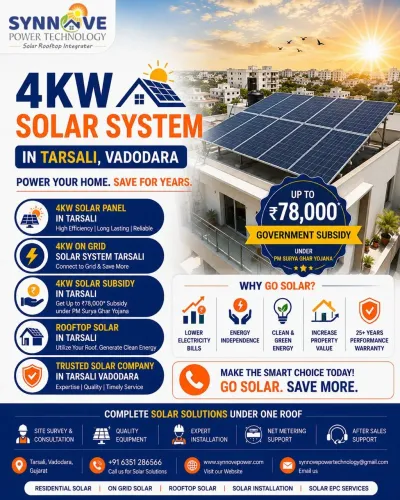
A 2.16–2.18 kWp system (four 540–545 Wp panels) sits right at the top of the subsidy window and suits many households with moderate monthly consumption. If your usage is much higher, a 3 kW system gets the larger central subsidy (₹78,000) but no state top-up, so compare both options on total cost and long-term savings, not just upfront price.
How to apply: step by step
Register on the PM Surya Ghar national portal with your state, DISCOM and consumer number.
Apply for rooftop solar and get feasibility approval from your DISCOM.
Get the system installed by a vendor registered on the portal.
Submit installation details and apply for net metering.
DISCOM inspects, installs the net meter and issues the commissioning certificate.
Add your bank details. Subsidies are credited by DBT.
Documents you need
Latest electricity bill
Aadhaar and PAN
Property tax bill or ownership proof
Cancelled cheque or bank passbook
Frequently asked questions
Is solar really available for ₹10,000 in Gujarat? Only the household's share of the benchmark cost is about ₹10,000 for a roughly 2.16 kWp system. Your actual cost depends on the installer's quote and what is included.
Do SC/ST households get more? Yes. They pay 5% of the benchmark cost instead of 10%, which is about ₹5,360 for a 2.16 kWp system.
I installed solar before 22 October. Can I claim? No. The state top-up applies only to systems commissioned on or after 22 October 2026.
Can I get a loan? Under PM Surya Ghar, nationalised banks offer collateral-free rooftop solar loans. Ask your bank for current rates and terms.
Talk to Synnove Power Technology
Synnove Power Technology is a solar EPC company based in Vadodara, handling site design, procurement, installation and net-metering support. Contact us for a site survey and a transparent written quote showing your exact cost after central and state subsidies.
Get a free site survey and quote.
synnovepowertechnology@gmail.com
+91 63512 86566
Keywords